
Buying an investment property: how rental income and equity affect what you can borrow
By Clara Kowalski · Updated 2026-07-21

Borrowing power for an investment property works a little differently to buying a home you plan to live in, mainly because lenders weigh rental income and your existing equity into the calculation. Understanding how these factors combine helps set realistic expectations before you start looking at properties.
How rental income gets factored in
Lenders generally do not count 100% of a property’s expected rental income toward your borrowing power. Instead, most apply a discount, commonly counting somewhere around 70 to 80% of the expected rent, to account for vacancy periods, management fees, and maintenance costs that reduce the income you actually receive. The exact figure and method vary by lender, which is one reason borrowing power estimates can differ noticeably between institutions for the same property.
Using equity from an existing property
If you already own a home or another property with equity built up, that equity can often be used as security for an investment purchase, sometimes without needing a separate cash deposit. This is a common strategy for building a property portfolio, since it lets equity growth in one property support the purchase of the next, though the lender will still assess your overall serviceability, not just the available equity. If you are timing a purchase around selling another property rather than building a portfolio, our guide on bridging finance covers financing that gap.
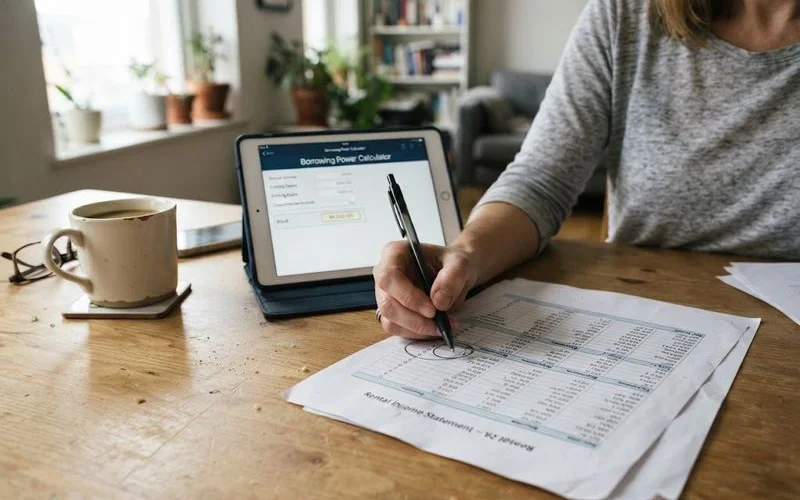
What lenders weigh together
| Factor | How it affects borrowing power |
|---|---|
| Expected rental income | Counted at a discounted rate, commonly 70 to 80% |
| Existing home loan repayments | Reduces capacity available for a new loan |
| Available equity | Can fund deposit or security without new cash |
| Overall income and expenses | Assessed alongside rental income, not replaced by it |
| Interest rate buffer | Lenders test serviceability at a higher rate than the actual offer |
Why serviceability tightens with each additional property
Every additional investment property adds a loan repayment to your overall financial picture, even though it also adds rental income. Lenders assess the net effect, and because rental income is only partially counted while the full repayment obligation is, borrowing power for a third or fourth property typically grows more slowly than the first or second, all else being equal.
Getting a realistic borrowing estimate
Because rental income treatment and equity policies differ meaningfully between lenders, a borrowing power figure from one lender’s online calculator can be quite different from what another lender would actually approve. A broker who compares across a panel can identify which lenders are likely to assess your specific situation, existing properties, income structure, and target rental yield, most favourably.
The interest rate buffer lenders test against
When assessing whether you can afford a loan, lenders do not just look at the actual rate on offer, they test your serviceability against a buffer rate, often several percentage points above the current rate, to check you could still manage repayments if rates rose. This buffer applies to investment loans just as it does to owner-occupier loans, and it is one of the reasons a borrowing power figure can feel more conservative than a simple repayment calculation based on today’s rate might suggest. Understanding this buffer helps explain why two loans with the same current repayment can have different approved borrowing limits depending on the lender’s specific buffer policy.
Structuring for future purchases
If building a portfolio of more than one property is the longer-term goal, it is worth discussing loan structure with a broker from the first purchase, rather than treating each property as a standalone decision. Choices like which lender holds which loan, whether to cross-collateralise properties as security, and how you structure offset accounts can all affect how much borrowing capacity remains available for a future purchase. Getting this right early tends to matter more the further into a portfolio you go.
Comparing investment property finance specialists is a practical way to get a realistic borrowing estimate before you start seriously searching, and our scoring method explains how we assess them. You can also browse the full directory if you would like more options, particularly if you are weighing several lenders’ rental income and equity policies against each other.
FAQ
- How much of the expected rental income can lenders count toward my borrowing power?
- Most lenders count a portion of expected rental income, commonly around 70 to 80%, rather than the full amount, to allow for vacancy periods and expenses. The exact percentage varies by lender.
- Can I use equity in my current home to buy an investment property?
- Yes, this is a common approach. Equity in an existing property can often be used as security or a deposit for an investment purchase, subject to the lender's assessment of your overall position.
- Does owning an investment property affect how much I can borrow for a future purchase?
- Yes. Lenders factor in the existing loan's repayments alongside your other debts and income when assessing capacity for additional borrowing, so each subsequent purchase is assessed against your full financial picture, not in isolation.
- Are interest rates different for investment loans compared to owner-occupier loans?
- Often slightly higher, reflecting the marginally higher risk lenders associate with investment lending, though the gap and specific terms vary by lender.