
Car finance vs redrawing your home loan: which costs less
By Clara Kowalski · Updated 2026-07-12

Buying a car often raises a genuine question if you already have a home loan with extra repayments sitting in redraw: use that redraw, or take out dedicated car finance instead. Both can work, but they behave quite differently once you look past the headline rate.
How each option actually works
Redrawing from your home loan means withdrawing extra repayments you have already made above the minimum, using them to fund the car purchase. You are not taking on new debt in a formal sense, you are simply using money that was sitting ahead in your existing loan, which then needs to be paid back down again like any other home loan balance.
Dedicated car finance is a separate loan, secured against the vehicle itself, usually with a fixed term (often three to seven years) and a fixed or variable rate specific to car lending, which is typically higher than a home loan rate because the security (a depreciating car) carries more risk for the lender than a house.
Where the trade-off actually lands
The interest rate on a home loan redraw is usually lower than dedicated car finance, which sounds like an easy win. The catch is repayment structure: if you redraw and do not deliberately pay that amount back down on a defined schedule, it can effectively stretch out over your remaining home loan term, which might be twenty or more years. Even at a lower rate, paying a car off over two decades can cost more in total interest than a five-year car loan at a higher rate.
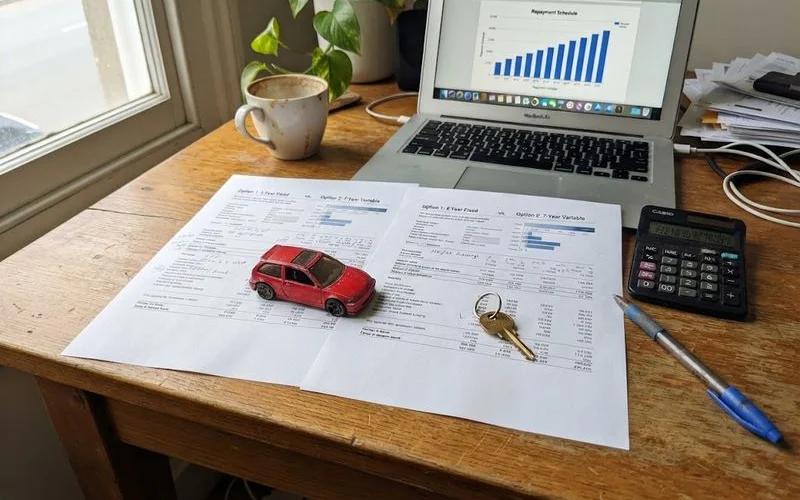
Side-by-side comparison
| Factor | Home loan redraw | Dedicated car finance |
|---|---|---|
| Typical interest rate | Usually lower | Usually higher |
| Repayment term | Open-ended unless you set a plan | Fixed, often 3 to 7 years |
| Total interest risk | Can be high if left unstructured | Predictable, tied to the fixed term |
| Effect on home loan buffer | Reduces available redraw funds | No effect on home loan |
| Best suited to | Disciplined borrowers who will set a repayment plan | Anyone wanting a fixed, self-contained payoff timeline |
Making the redraw option work
If you do use redraw for a car, the option tends to work best when you treat it like a separate loan mentally: work out what a car loan repayment would look like over five years at a comparable rate, and consciously pay that same amount back into your home loan on top of your normal repayments. This captures the lower rate benefit without letting the cost quietly stretch across decades.
When dedicated finance is the simpler choice
If you would rather not manage that discipline yourself, or you want to preserve your home loan redraw buffer for emergencies or future extra repayments, dedicated car finance with a fixed term is often the more straightforward option, even at a higher headline rate. A broker who works across car and home lending can quote both paths side by side before you decide; our guide on how using a mortgage broker works explains what to expect from that conversation.
Do not overlook depreciation
A car loses value from the moment you drive it away, which is a factor worth weighing regardless of which finance path you choose. Structuring a car purchase against your home, an appreciating asset, over a very long, unstructured timeframe means you can end up owing considerably more than the car is worth for a stretch of that period. This is not necessarily a reason to avoid the redraw option, but it reinforces why setting a defined repayment plan matters more with a depreciating purchase than it might for other uses of redraw funds, such as renovations that could add value to the property itself.
A quick way to decide
If you already have strong repayment discipline and a clear plan to pay the amount down within a set number of years, redraw usually wins on cost. If you would rather the debt structure enforce that discipline for you, or you want your home loan redraw kept free for other purposes, dedicated car finance is the simpler and often safer default, even though it costs a little more in interest.
If you want to compare structured car finance options locally, our car finance and loan specialists can talk through both paths, and our scoring method explains how we assess them. You can also browse the wider directory if you want more options.
FAQ
- Is a home loan redraw always cheaper than car finance?
- Often the interest rate is lower, since it is secured against your home, but that is only part of the comparison. Extending your home loan term to cover the car cost can add more total interest than a shorter dedicated car loan, depending on how you structure repayments.
- Do I need redraw available on my home loan to use this option?
- Yes, redraw needs to be an active feature on your loan and you need extra repayments sitting in it. Not every home loan has redraw, and some restrict how it can be accessed.
- Does using a redraw for a car affect my home loan in other ways?
- It reduces your available buffer of extra repayments, which can matter if you were relying on that buffer for financial flexibility or to shorten your loan term.
- Is dedicated car finance ever the better choice even at a higher rate?
- Yes, particularly if you want the debt cleared on a fixed, shorter timeline, or if you want to keep your home loan redraw buffer intact for other purposes.